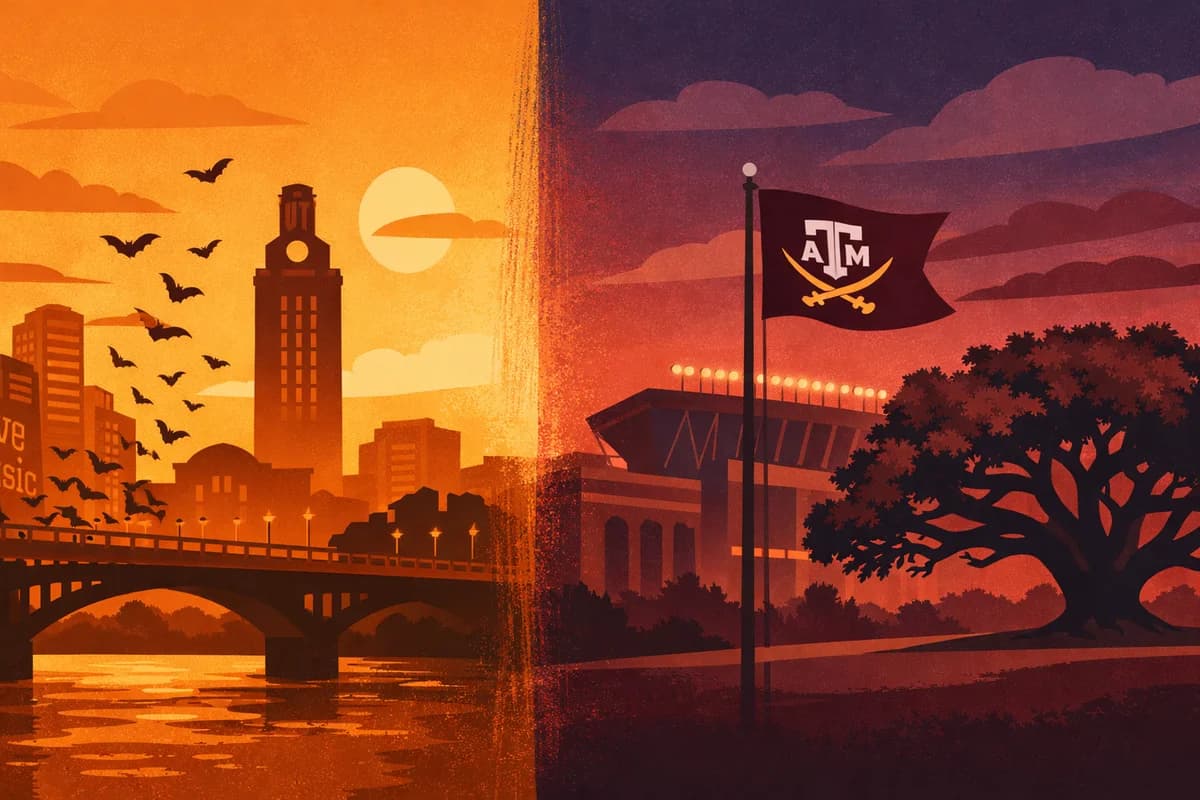
In Texas, this isn't just a college decision — it's practically a family loyalty test. The UT Austin vs Texas A&M rivalry cuts through football games, bumper stickers, and dinner table arguments in a way that few college rivalries can match. And every year, thousands of students have to actually decide between them.
Here's the thing: both schools are genuinely excellent, and both are enormous values for Texas residents. But they are profoundly different institutions in culture, academic identity, and the kind of person they tend to produce. Choosing based on vibes or family tradition is a real mistake when the right analytical answer is usually pretty clear.
Let's break this down properly.
Quick Comparison: UT Austin vs Texas A&M
| UT Austin | Texas A&M | |
|---|---|---|
| Location | Austin, TX | College Station, TX |
| Acceptance Rate | ~31% | ~63% |
| In-State Tuition | ~$11,500/yr | ~$12,500/yr |
| Out-of-State Tuition | ~$40,000/yr | ~$40,000/yr |
| Undergrad Enrollment | ~40,000 | ~57,000 |
| Known For | Business, CS, Engineering, Liberal Arts | Engineering, Agriculture, Business, Military traditions |
| Campus Vibe | Urban, tech-forward, progressive, eclectic | Traditional, community-driven, proud, conservative |
| Alumni Network | Strong in tech, entertainment, policy | Largest alumni network in the world by some counts |
Tuition figures are approximate; verify with each school for your enrollment year.
The Real Difference: Academic Identity
Both schools are academic powerhouses. But they were built for different things, and that still shows up in the culture and the student body today.
The University of Texas at Austin is a comprehensive research university with elite-level programs across an enormous range of disciplines. The McCombs School of Business is consistently ranked among the top undergraduate business schools in the country. The Cockrell School of Engineering and the CS department are world-class and feed directly into the Austin tech ecosystem — Dell, Apple, Tesla, Google, and hundreds of startups all recruit heavily from UT. The School of Journalism and the liberal arts programs are strong. Pre-law is serious business here. The LBJ School draws policy-minded students from across the country.
UT Austin also has Top Gun liberal arts — the Plan II Honors program is one of the most demanding and rewarding interdisciplinary programs at any public university in America. If you're intellectually curious across multiple domains, Plan II is worth knowing about.
Texas A&M University is a land-grant institution with a deep engineering and agricultural tradition that has evolved into a major research university while keeping its roots visible. Engineering at A&M — particularly petroleum, aerospace, civil, and chemical engineering — is genuinely world-class. The Mays Business School is strong. Agriculture and life sciences are excellent. The Bush School of Government and Public Service is one of the better public policy programs in the South. And the Corps of Cadets military program produces a disproportionate share of military officers from any civilian institution.
The honest academic summary: UT's breadth is wider. If you're studying business, CS, liberal arts, communications, policy, or law, UT gives you more options at a higher level. If you're going into engineering (especially petroleum or aerospace), agriculture, or veterinary medicine, A&M is as strong as anywhere — and the alumni network in those industries is arguably stronger than UT's.
Austin vs College Station: Two Very Different Worlds
This might be the most important comparison in the whole article. Where you go to school shapes who you become in ways that academics alone can't capture.
Austin is one of the fastest-growing cities in the United States. It's the state capital, a major tech hub, a live music capital, and one of the most interesting cities in the country for anyone in their 20s. As a UT student, you're not just going to college in Austin — you're part of Austin. West Campus housing puts students in the middle of an urban neighborhood. Sixth Street is famous. The Congress Avenue bridge bats (1.5 million Mexican free-tails, look it up) are wild. You can take an Uber to internship interviews at Dell or Google. You can see live music any night of the week. The Texas State Capitol is a 15-minute walk from campus.
The flip side: Austin is increasingly expensive. Housing costs have risen dramatically. The city is sprawling and car-dependent outside of the university area. The character of Austin is shifting as it grows, and some longtime Austinites are not thrilled about it. But for a college student in 2026, Austin is one of the best cities in the country to be in your early 20s.
College Station is a college town built almost entirely around Texas A&M. About 120,000 people, over half of whom are affiliated with the university in some way. This creates an intense community that Aggies love and that the A&M culture thrives in. Kyle Field — capacity 102,500 — is one of the loudest, most atmospheric stadiums in college football. The traditions are genuine and deep: Midnight Yell, Muster, the 12th Man, Silver Taps. These aren't just marketing gimmicks; they're things A&M students and alumni actually feel.
The tradeoff is real: College Station offers very little outside of A&M. If you're someone who needs urban energy, cultural diversity, a music scene, or career infrastructure outside of campus recruiting, College Station doesn't provide those things. The campus IS the city in a way that's even more pronounced than Happy Valley at Penn State.
Net result: Austin gives you the world. College Station gives you A&M. Which you want more is a genuine self-knowledge question.
Still deciding? FindMySchool.ai matches you with schools based on YOUR priorities — not just rankings. Take the 5-minute quiz →
The A&M Alumni Network: Is It Really That Special?
Texas A&M claims one of the largest alumni networks in the world — the Association of Former Students has over 500,000 dues-paying members, which is genuinely unusual. Aggies famously hire other Aggies. The informal network is strong across Texas industries — energy, agriculture, defense, construction, finance — and extends nationally.
What makes it different from most alumni networks is the emotional connection. A&M alumni don't just loosely identify with their school; many of them are deeply, actively loyal to it. When an Aggie asks "Where'd you go to school?" and you say "A&M," you've unlocked something. That's not marketing — it's something graduates from the school consistently report experiencing in the real world.
UT Austin's alumni network is also massive and strong — particularly in tech, entertainment, journalism, and policy. If you want to work at a major tech company or a media firm, having "UT" on your resume opens real doors. The difference is that UT's network tends to be more industry-specific (tech, business, politics), while A&M's tends to be more geographically concentrated in Texas and more cross-industry within the state.
If you want to build a career in Texas across almost any industry: A&M's network is hard to beat. If you want a career in tech, entertainment, or national politics: UT's network reaches further.
Traditions and Culture: A Genuine Difference
UT Austin is many things, but it is not a traditions-heavy school in the way that A&M is. UT's culture is more individualistic, more progressive politically, and more oriented toward external Austin culture than toward campus ritual. Students are proud of UT, but the pride is more cerebral and less communal than A&M's.
Texas A&M is built on traditions in a way that is almost sui generis in American higher education. The Corps of Cadets, Midnight Yell Practice, Aggie Muster, the War Hymn, the 12th Man — these aren't just things that happen; they're part of what it means to be an Aggie. The school explicitly cultivates a culture of loyalty, service, and community. Many students choose A&M specifically because they want to be part of that culture, and they are not disappointed.
This cultural difference is real and it matters. Students who thrive at A&M tend to value community, tradition, and belonging. Students who thrive at UT tend to value independence, urban stimulation, and academic variety. Neither is better — they're different values.
Football: THE Texas Rivalry
UT and A&M were in the same conference for over a century and played every Thanksgiving weekend in one of college football's great rivalries. They separated in 2011 when A&M joined the SEC and UT stayed in the Big 12 (and is now also in the SEC). The game went on hiatus for over a decade before plans to resume it generated enormous excitement across the state.
UT football has produced more Heisman Trophy winners than almost any program. Darrell K Royal Texas Memorial Stadium is a beautiful facility in the heart of Austin. The program has had ups and downs but remains a national brand.
A&M football at Kyle Field is a different emotional experience than almost anything in college sports. The atmosphere — particularly at night games — is regularly cited as one of the best in the country. The program has produced notable NFL talent and competes at the top of the SEC.
If you're going to UT or A&M partly for football, you're going to a great football school either way. The difference is atmosphere: Kyle Field at night in College Station hits differently than DKR in Austin, though Austin has the city to go back to after the game.
The Verdict
Pick UT Austin if: You want the broadest academic options at a world-class level. You're going into tech, business, communications, policy, or law. You want to live in one of the best cities in the country during college. You want urban energy, career infrastructure, and access to a massive city. You're the kind of student who does best with more freedom and less structure.
Pick Texas A&M if: You're studying engineering (especially petroleum, aerospace, or chemical), agriculture, or veterinary medicine. You want to be part of a deeply loyal, tradition-rich community that will follow you throughout your career. You're planning to build a career primarily in Texas industries like energy, agriculture, or defense. You want college to feel like belonging somewhere — a community, not just a university. You value structure, tradition, and the A&M culture.
The Texas rivalry is real. Both schools have fiercely loyal alumni who will insist you made the wrong choice if you went to the other one. Ignore all of that. Make your decision on where you want to live, what you want to study, and what kind of community you want to build. Get that right and you'll be proud of your choice no matter which one you make.
Still deciding? FindMySchool.ai matches you with schools based on YOUR priorities — not just rankings. Take the 5-minute quiz →